
Built for the people who act on the evidence.
Each group below faces a different problem. For each, we set out what Climate Probity helps it see, what it might receive, the action that output could support, why it can be trusted, and what it does not establish.
Funders and development-finance institutions, oversight and accountability bodies, and philanthropic funders. The institutions whose decisions this work is built to support first.
Implementing entities, civil society, journalists, and researchers. Each gains a different kind of value from the same evidential discipline.
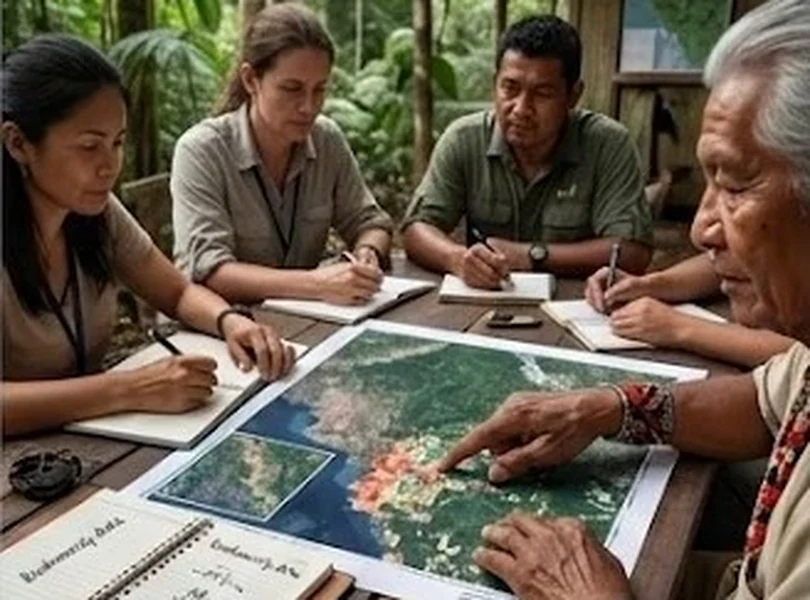
Communities affected by climate projects. A central reason the public-interest work exists, distinct from the institutional decision-support users.
Funders & development-finance institutions
You fund climate programs through many channels and need to know which records deserve a closer look before a problem becomes public or systemic.
Where reported results, procurement, and counterparty records show gaps, inconsistencies, or relationships that warrant review across a portfolio.
A prioritized set of projects, each with the specific question behind it and links to the underlying source records.
Direct assurance, supervision, or follow-up toward the records most likely to need it, rather than spreading attention evenly.
Every signal traces to identifiable documents and is reviewed by a person before it carries any weight.
A review priority is not a finding of misconduct, a risk score, or a measure of guilt.
Oversight, assurance, audit & integrity bodies
Your investigative capacity is small relative to the volume of climate-finance activity you are expected to cover.
Patterns and documented relationships across sources that a single-record review would be unlikely to reveal.
Source-linked concerns, each with a clear account of what the evidence does and does not support.
Decide whether a matter merits a formal review, with the evidential basis already organized for you.
The analysis preserves the distinction between an indicator, a review question, and a finding at every step.
Analytical signals are not formal determinations and do not substitute for formal investigation.
Philanthropic funders & strategic partners
Accountability infrastructure for climate finance is thin, and disclosure alone has not closed the gap.
What a working proof of concept demonstrates, and what independent capacity it would take to operate at scale.
A clear account of current status, what funding would build, and how progress would be measured.
Decide whether to support a defined stage of development, against milestones you can check.
The platform separates demonstrated capability from intended capability, and independence is built into its governance.
Support does not purchase influence over findings, advance sign-off, or any claim of endorsement.
Accredited & implementing entities
You carry the burden of showing that your reporting holds up to outside scrutiny.
How your records read against the available evidence, with the opportunity to respond before anything is published.
A clear account of any concern, its basis, and a route to reply or to correct the record.
Address a documentation gap early, or provide the context that resolves it.
Right of reply, correction, and version control are part of the process, not exceptions to it.
A review question is not an allegation of wrongdoing.
Civil-society & watchdog organizations
You have strong public-interest motivation but limited access to organized, source-linked evidence.
Public-interest concerns presented with their evidential basis and their limits stated plainly.
Source-linked records you can examine, cite, and build on in your own work.
Focus advocacy and research where the documented evidence is strongest.
Conclusions show their sources, their limits, and any response received from the subject.
A documented concern is not proof of an outcome or of intent.
Investigative journalists
Climate-finance stories require tracing money and relationships across scattered records, under deadline.
Documented relationships and source records assembled in one place, each with its provenance.
A traceable trail from a public concern back to the primary documents behind it.
Verify independently and report with the sourcing already visible.
Each claim is tied to identifiable records, not to an opaque score.
The platform surfaces what records support. It does not assert intent, causation, or guilt.
Academic & policy researchers
Studying climate-finance integrity requires consistent, traceable data across fragmented sources.
Structured, source-linked information suitable for systematic analysis.
Documented patterns and records that can be examined, tested, and cited.
Ground policy analysis in traceable evidence rather than anecdote.
Methods preserve the distinction between correlation and proof.
An observed pattern is not a causal claim.
Affected communities & their advocates
People closest to a project often have the least access to the records that affect them.
Public-interest findings about relevant projects, in plain language, with their evidential basis.
Readable, source-linked accounts of concerns relevant to a community.
Raise informed questions with the institutions accountable to them.
Findings are reviewed, proportionate, and open to response and correction.
A concern under review is not a verdict.
Not sure where your organization fits?
Tell us the problem you are trying to solve. A briefing can show how the proof of concept relates to your oversight, assurance, or public-interest work.